

Cosmetic dentistry · Finchley
Dental veneers in Finchley — careful planning, honest advice
Veneers can change the colour, shape and proportion of selected teeth. At 110 Total Dentistry on Ballards Lane we explain preparation, alternatives and long-term implications clearly before any treatment is recommended.
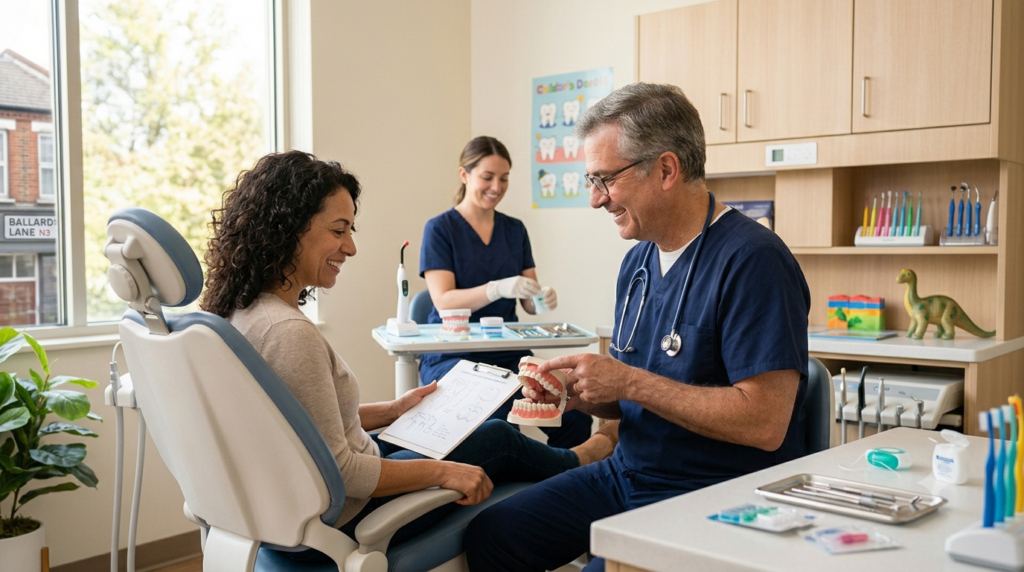
Understanding veneers
What dental veneers are
A dental veneer is a thin shell — made from porcelain or composite resin — that is bonded to the visible front surface of a tooth. It is primarily a cosmetic solution used to alter a tooth’s colour, shape, length or surface texture. The underlying tooth structure remains largely intact, though porcelain veneers do require a small, permanent reduction of enamel.
When another treatment may suit you better
- Discolouration only — professional whitening is worth trying first; it preserves tooth structure entirely.
- Alignment concerns — orthodontics or clear aligners address the underlying position rather than masking it.
- Minor chips — composite bonding requires little or no preparation and is reversible in many cases.
We discuss all options openly at consultation.

Veneers are most appropriate when the teeth are otherwise healthy but have one or more of the following characteristics:
Persistent discolouration not fully corrected by professional whitening
Chips, worn edges or uneven surface texture
Minor discrepancies in shape or length between adjacent teeth
Small gaps where the cosmetic result from orthodontics or bonding alone is not preferred
Porcelain vs composite veneers
| Porcelain | Composite | |
|---|---|---|
| Preparation | Usually required (permanent) | Minimal or none in many cases |
| Stain resistance | Very high | Moderate — susceptible to dietary staining |
| Repairability | Usually replaced if damaged | Can often be repaired or added to |
| Longevity | Longer (individual variation) | Shorter (individual variation) |
| Reversibility | Generally irreversible | Often more reversible |
| Appointments | Typically 2 or more | Often completed in 1 visit |
| Cost | Higher — see fee note below | Lower — see fee note below |
Both materials have appropriate applications. Your clinician will advise which is suitable for your teeth and the outcome you are looking to achieve.
Assessment
Who may be suitable for veneers
Veneers are only appropriate where the teeth and gums are in good health. Before any cosmetic treatment is planned, Dr Assaker carries out a thorough assessment that includes:
- An oral health examination — decay and gum disease must be treated first
- Bite and occlusion assessment — clenching or grinding can place excessive load on veneers
- Enamel check — sufficient enamel is needed to support a durable bond
- Discussion of your expectations and preferred outcome
- Photographs and, where needed, X-rays to understand tooth anatomy
Patients with heavily worn bites, active bruxism, significant alignment issues or insufficient remaining enamel are typically not suitable candidates for veneers without addressing those factors first.
Preparing a tooth for a porcelain veneer involves permanently removing a thin layer of enamel from its front surface. Enamel does not regenerate. Once this preparation is carried out, the tooth will always require a veneer or comparable restoration.
This is not a reason to avoid veneers if they are the right choice for you — but it is something we explain in full at consultation, so that you can weigh it alongside the expected benefit and any alternatives before making your decision.
The process
Veneer treatment stages at 110 Total Dentistry
A comprehensive oral health check, photographs and bite assessment. All suitable options — including whitening, bonding and orthodontics — are discussed. If veneers are appropriate, a treatment plan and fee estimate are provided.
Tooth shade, length and shape are agreed before any preparation begins. This stage allows you to visualise the intended result and raise questions before a permanent commitment is made.
Under local anaesthetic, a small amount of enamel is carefully removed from the tooth surface. Impressions or digital scans are taken and sent to the dental laboratory. Temporary veneers are usually placed to protect the prepared teeth in the interim.
When the laboratory returns the finished veneers, they are placed on the teeth without permanent bonding so that shade, shape and fit can be assessed. Adjustments can be requested at this stage.
Once you are satisfied with the result, the veneers are permanently bonded to the tooth surface using a dental adhesive. Excess material is removed and the bite is checked.
A follow-up appointment, usually a few weeks after fitting, checks the fit, gum response and bite. Ongoing hygiene appointments help maintain the surrounding gum tissue and protect the bond.
Comfort and aftercare
Local anaesthetic is used during preparation so the appointment itself is comfortable. After the anaesthetic wears off, some sensitivity to temperature is common for a few days. Temporary veneers should be treated gently — avoid hard or sticky foods during this period.
Once permanent veneers are fitted, normal brushing and flossing continues as usual. Avoid biting directly on very hard objects (for example, bottle tops or hard sweets), as this can cause fracture.


Risks and considerations
- • Sensitivity — increased sensitivity during and after preparation is a recognised side effect and is usually temporary.
- • Irreversibility — enamel removal for porcelain veneers is permanent (see note above).
- • Colour matching — if adjacent natural teeth stain over time, a visible difference may develop.
- • Fracture — veneers can chip or crack if subjected to excessive force.
- • Gum changes — changes in gum level over time can affect the appearance of the veneer margin.
Longevity and maintenance
How long veneers last is influenced by the material used, the quality of the bond, your diet and bite habits, and how consistently you maintain oral hygiene. Porcelain veneers can remain in good condition for ten years or more in favourable circumstances; composite veneers typically require earlier replacement or repair.
Regular dental examinations and hygiene appointments — every six to twelve months — allow potential issues to be identified early and help protect the gum tissue around veneers.
Fees
Veneer pricing
Veneer fees are provided on consultation. The total cost depends on the material chosen (porcelain or composite), the number of teeth being treated, and the clinical complexity of your case. A written fee estimate is provided before any treatment begins.
For reference, the new patient examination fee is £75 and routine examinations are £45. These are separate from the veneer treatment cost.
If whitening or composite bonding may be a more appropriate first step for your situation, we will say so — those fees are available on the fees page.
Your clinician
Dr Kozhaya Assaker
Dr Assaker holds a DDS (2002) and a postgraduate qualification in Oral Biology (2003), followed by a Diploma in Oral Surgery and Implantology (2007). He has undertaken further specialist training in Switzerland, the United States and France. GDC number: 176427.
Dr Assaker is a member of the British Dental Association (BDA) and holds international memberships in the field of implantology. He consults in English, Arabic, French, Armenian and some Polish.
Cosmetic work at 110 Total Dentistry is approached within the context of overall oral health — veneers are only planned after a full examination confirms the teeth and gums are in a condition to support them.
Common questions
Crown & bridge FAQs
Porcelain veneers typically require a small but permanent amount of enamel to be removed from the front surface of the tooth. Because enamel does not grow back, this means the tooth will always require a veneer or similar covering going forward. This is explained in full during your consultation so you can make an informed decision. Composite veneers may require minimal or no preparation in certain cases, depending on the tooth's existing shape and the degree of correction needed.
No. The enamel removal required for porcelain veneers is permanent and cannot be undone. This is an important consideration and is one reason we discuss all suitable alternatives — including composite bonding and teeth whitening — before recommending veneers. If you have any doubts, it is always reasonable to explore reversible options first.
Longevity varies considerably between individuals and depends on the material chosen, the quality of the bond, your bite, and how well you care for your teeth. Porcelain veneers can last ten years or considerably longer with attentive maintenance; composite veneers typically have a shorter lifespan but are easier to repair. No specific lifespan can be guaranteed for any individual patient.
Porcelain veneers are highly resistant to staining and generally maintain their shade well. However, the natural teeth around them can stain, which may create a mismatch if you later have whitening on your other teeth. Composite veneers are more susceptible to picking up colour from tea, coffee, red wine and tobacco. This is one reason the order of treatments — whitening before veneers, if relevant — matters and is discussed at assessment.
Composite veneers that chip or wear can often be repaired or built up relatively straightforwardly. Porcelain veneers that crack or fracture usually need to be replaced entirely rather than repaired, because the ceramic material cannot easily be patched. Your dentist will advise on the best course of action if a veneer is damaged.
Porcelain veneers typically require at least two clinical appointments: one for examination, shade selection and tooth preparation, and a second for fitting once the laboratory has produced the veneers. Temporary veneers may be placed in the interim. A review appointment is usually arranged some weeks after fitting. Composite veneers are often completed in a single visit.
Some patients notice increased sensitivity to temperature in the days following tooth preparation and fitting. This is a recognised side effect of enamel removal and is usually temporary. Local anaesthetic is used during any preparation to ensure comfort at the time. If sensitivity persists or is severe, you should contact the practice.
Related treatments
Other cosmetic options at 110 Total Dentistry
From £290 home / £390 in-surgery
Minimal preparation for minor chips
From £1,700 — addresses alignment
Book a veneer consultation in Finchley
110 Total Dentistry is on Ballards Lane, a short walk from Finchley Central station (Northern line).We discuss every option clearly — including whether veneers are the right choice for your situation — before any treatment is agreed.