
teeth-whitening-finchley

Cosmetic dentistry · Finchley

Professional teeth whitening in Finchley

Dentist-assessed, clinically supervised whitening tailored to your teeth, your timeline and your sensitivity — in surgery or at home, with honest expectations set at every stage.

From £390

In-surgery whitening

From £290

Home whitening kit
What it involves

How professional teeth whitening works

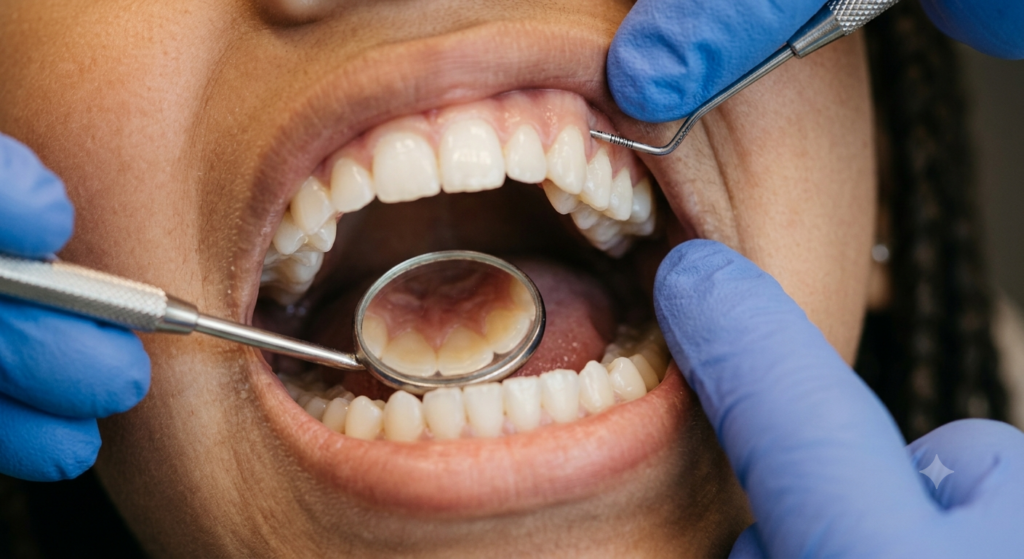
Professional teeth whitening uses a peroxide-based gel to lighten the natural colour of tooth enamel and dentine. The gel penetrates the outer layers of the tooth, breaking down the molecular bonds that cause discolouration — including staining from tea, coffee, red wine, certain foods and the gradual yellowing that occurs with age. The process does not alter the structure of your teeth or damage the enamel when carried out under dental supervision at appropriate concentrations.

It is important to understand what whitening can and cannot do before you begin. Whitening works on natural enamel. It does not change the colour of porcelain crowns, composite bonding, white fillings or veneers — any existing restorations will remain their original shade. If you have visible restorations on front teeth, your dentist will discuss how this affects the likely outcome and whether any adjustment is needed afterwards.

Shade improvement varies between individuals. Deeply stained teeth, grey or tetracycline-related discolouration and intrinsic staining respond differently to surface staining. A specific number of shades cannot be guaranteed — your dentist will give you a realistic, personalised expectation at assessment.

Suitability and who should wait

Suitability and who should wait

Whitening is suitable for most adults with healthy teeth and gums who would like a lighter natural tooth colour. You may find it particularly worthwhile if your teeth have become stained through diet or lifestyle, or if gradual yellowing has developed over time.

Whitening is not recommended in the following situations, and your dentist will identify these at the assessment:

  • Active tooth decay or untreated gum disease (treatment is required first)
  • Pregnancy or breastfeeding (not recommended; postpone until after this period)
  • Severe existing sensitivity that has not been assessed
  • Children and patients under 18
  • Teeth where the discolouration is intrinsic or related to medication (results may be limited; alternatives such as veneers may be more appropriate)
Combination planning

Whitening before bonding or veneers

If you are also considering composite bonding or porcelain veneers, the sequence matters. Composite resin and ceramic materials are shade-matched to your existing tooth colour at the time of placement. If you whiten after having restorations placed, the natural teeth will become lighter but the restoration will not — creating an obvious mismatch. Completing your whitening course first, allowing the shade to stabilise, and then having bonding or veneers placed means the restoration can be matched to your brightened, settled tooth colour. Your dentist will advise on the appropriate interval between treatments.

Your options

In-surgery or home whitening kit?
Both options use professionally prescribed whitening products. The right choice depends on your teeth, your timeline and your sensitivity. Your dentist will advise at assessment.
In-Surgery Whitening

From £390

Home Whitening Kit

From £290

The process

What to expect, step by step
01
Dental assessment
Before any whitening product is prescribed, your dentist examines your teeth and gums to confirm there is no active decay, gum disease or other issue that would make whitening unsuitable or uncomfortable. Existing restorations are noted and their likely appearance post-whitening is discussed.
02
Shade record and expectation setting
Your current tooth shade is recorded. Your dentist discusses the realistic range of improvement for your particular teeth and explains what whitening can and cannot change — including any restorations that will remain their current shade.
03
Impressions and shade matching
For a home kit, precise impressions of your upper and lower teeth are taken so that custom-fitted whitening trays can be made. You will return to collect your trays along with your prescribed whitening gel and written instructions. For in-surgery whitening, treatment is carried out in practice during a single appointment.
04
Whitening course
Home kit patients wear their trays as directed — typically for a prescribed number of hours per day over two to four weeks, depending on the gel concentration and your desired outcome. In-surgery patients have the treatment applied and monitored by the dental team at the practice.
05
Review
Once your course is complete, your dentist can review the result. If you are proceeding to bonding, veneers or any shade-matched restoration, this is the appropriate point to schedule those appointments — after allowing the shade to settle.
In-surgery whitening
From £390
Home whitening kit
From £290
New patient examination
£75
Routine examination
£45

Your dentist

Meet Dr Kozhaya Assaker

Dr Assaker holds a DDS (2002) and a postgraduate qualification in Oral Biology (2003), followed by a Diploma in Oral Surgery and Implantology (2007). He has completed further training in implantology and bone grafting in Switzerland, the USA and France.

He is a member of the British Dental Association (BDA) and holds active membership with the European Association for Osseointegration (EAO) and the International Team for Implantology (ITI). GDC registration number: 176427.

Dr Assaker consults in English, Arabic, French, Armenian and some Polish.
Common questions

Crown & bridge FAQs
Teeth whitening carried out under dental supervision, using properly prescribed products at regulated concentrations, is considered safe. The key requirement is a dental assessment beforehand to confirm that your gums are healthy, no active decay is present and that whitening is appropriate for your teeth. Products sold online or in beauty salons without dental assessment bypass these checks and carry real risks, including gum irritation, uneven results and masking underlying dental problems.
Results vary considerably between individuals and depend on diet, habits such as smoking, and how well the advice on post-treatment care is followed. Avoiding strongly pigmented foods and drinks — particularly coffee, tea, red wine and berries — in the days immediately after treatment helps preserve the initial result. With good oral hygiene and sensible dietary habits many patients find their results last well for a year or more, after which a top-up treatment may be considered. No specific duration can be guaranteed.
This is one of the most common questions, and it is also the one we cannot answer with a specific number in advance. The degree of improvement depends on your natural tooth colour, the cause and depth of any staining, your age and the whitening system used. Your dentist will give you an honest, realistic expectation at the assessment — results are generally noticeable but should not be overstated.
Whitening should be completed first. Composite and ceramic materials used in bonding and veneers are shade-matched to your teeth at the time of treatment. If you whiten afterwards, your natural teeth will become lighter but the restoration will remain its original shade, creating a visible mismatch. Completing whitening first means the bonding or veneer can be matched to your new, brighter tooth colour.
Other cosmetic treatments at 110 Total Dentistry