

Restorative dentistry · Finchley
Root canal treatment in Finchley — relieve pain and keep your natural tooth
About 110 Total Dentistry
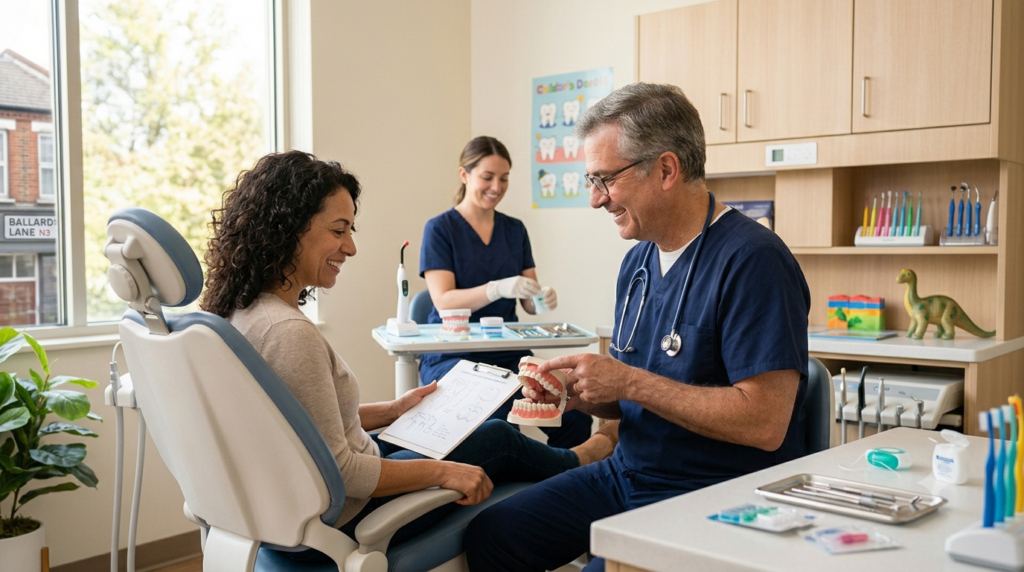
A private Finchley dental practice built around individual care
At 110 Total Dentistry on Ballards Lane, we take time to understand each patient’s needs, priorities and concerns before recommending a clear, personalised plan. Good dental care begins with honest conversation — not a prescription.
Whether you are registering for the first time, returning for routine care, or exploring options for a smile you have wanted to change, our team works at a pace that suits you. We speak English, Arabic, French and Armenian, and welcome nervous patients with additional time and care.
From our practice on Ballards Lane — a short walk from Finchley Central station — we provide preventive, restorative, emergency, implant, orthodontic and cosmetic dental care under one roof.
Why patients choose us
Full dental and medical history, including any medications
Clinical examination of all teeth and existing restorations
Periodontal (gum) health assessment with probing
Soft tissue examination of lips, cheeks, tongue and palate
Bite and jaw joint assessment
Radiographs if clinically indicated (£10 per view)
Written treatment plan with itemised fees before any work is agreed
Symptoms that may indicate root canal treatment is needed include:
- Severe, spontaneous or throbbing toothache
- Prolonged sensitivity to heat that does not subside
- A gum abscess, boil or persistent swelling near a tooth
- Facial swelling linked to a specific tooth
- Discolouration of a tooth (grey or darkening)
- Deep decay reaching the nerve, identified clinically or on X-ray
- Dental trauma resulting in nerve involvement
Facial swelling, difficulty swallowing, or rapidly spreading pain may indicate a serious spreading infection. Call 020 7998 7657 immediately, or attend your nearest A&E if you are unable to reach us. See our emergency dentist page for further guidance.
Treatment stages
Transparent fees
Fee snapshot
*Free child examination — please confirm eligibility when booking.
Find us
Your dentist near Finchley Central
Who may benefit
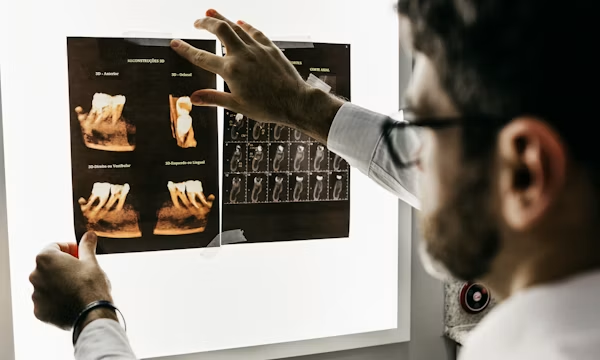
Root canal treatment is considered when the pulp tissue is irreversibly inflamed or infected but the tooth structure and surrounding bone are otherwise suitable for restoration. It may also be planned before placing a crown on a heavily broken-down tooth where the nerve is at risk. Your dentist will assess clinical and radiographic findings to determine whether treatment is appropriate for your situation.
Potential benefits
Relieves pain and clears infection in most cases Preserves the natural tooth and root Maintains bone support in the jaw Avoids the cost and complexity of tooth replacement A well-restored root-treated tooth can function for many years
Limitations and alternatives
Root canal treatment is successful in resolving symptoms in the majority of cases, but no outcome can be guaranteed — the result depends on individual anatomy, severity of infection and how well the tooth heals. In some situations extraction may be clinically recommended instead. Extraction is the main alternative. It is often quicker and less costly in the short term, but leaves a gap that may affect bite, adjacent teeth and bone density over time. Replacement options — implant, bridge or denture — each have their own costs and clinical requirements.
After treatment
Recovery, aftercare and longevity
What to expect after treatment
Crown placement and long-term care
Your dentist

Meet Dr Kozhaya Assaker
Dr Assaker holds a DDS (2002) and a postgraduate qualification in Oral Biology (2003), followed by a Diploma in Oral Surgery and Implantology (2007). He has completed further training in implantology and bone grafting in Switzerland, the USA and France.
He is a member of the British Dental Association (BDA) and holds active membership with the European Association for Osseointegration (EAO) and the International Team for Implantology (ITI). GDC registration number: 176427.
Dr Assaker consults in English, Arabic, French, Armenian and some Polish.
Common questions
Root canal treatment FAQs
This is the most common concern, and a very understandable one. Root canal treatment is carried out under local anaesthetic, so the tooth and surrounding area are numb throughout. Most patients find that the procedure itself is no more uncomfortable than having a filling. The reputation for pain largely relates to the infection that makes treatment necessary — not the treatment itself. Some tenderness in the days following is normal and settles with standard over-the-counter pain relief.
Most straightforward root canal treatments are completed over one or two appointments. More complex cases — for example, a heavily infected tooth with a complicated canal system — may require a further visit to allow the tooth to settle before the final seal is placed. Your dentist will give you a realistic estimate at your initial assessment.
Extraction removes the source of infection but leaves a gap. Over time, neighbouring teeth may drift, the opposing tooth can over-erupt, and the jawbone in the area may gradually reduce in density — a process called bone resorption. Replacement options (such as a dental implant, bridge or partial denture) are available but each carries its own cost, timeline and clinical considerations. Your dentist will explain both paths so you can make an informed choice.
Once the pulp tissue is removed, a tooth no longer receives nutrients through the same route and can become more brittle over time. A crown placed over a root-treated tooth protects it from the forces of biting and chewing, significantly reducing the risk of fracture. In some cases a large filling may be appropriate instead — your dentist will advise the most suitable option for your tooth.
Retreatment involves carefully removing a previous root canal filling, reworking the canal system and resealing the tooth. It is typically recommended where a tooth has not fully healed after an initial treatment, where infection has returned, or where the original filling has broken down. Retreatment is technically more involved than a first-time procedure and is charged at £700 per canal. Your dentist will take X-rays and assess whether retreatment is appropriate or whether an alternative approach is indicated.
Concerned about a tooth? Book an assessment in Finchley
Early assessment of an infected or painful tooth generally leads to a better outcome and more treatment options. Contact 110 Total Dentistry on Ballards Lane to arrange an appointment.